The console that writes your security policy is now the way in
Check Point's admin console was exploited pre-patch. CISA allowed three days. Detection, not patching, is the control that still works.

Check Point shipped a hotfix on 22 July for a flaw in the console that writes your security policy. CVE-2026-16232, rated 9.3, is an authentication bypass in the SmartConsole login flow: a remote, unauthenticated attacker obtains a session token and holds full administrative control of Security Management and Multi-Domain Management. Policy, rules, configuration, the lot.
It was being exploited before the fix existed. Check Point's VP of Research said a handful of customers had been targeted and notified.
CISA added it to the Known Exploited Vulnerabilities catalog the same day and set the federal deadline at 25 July.
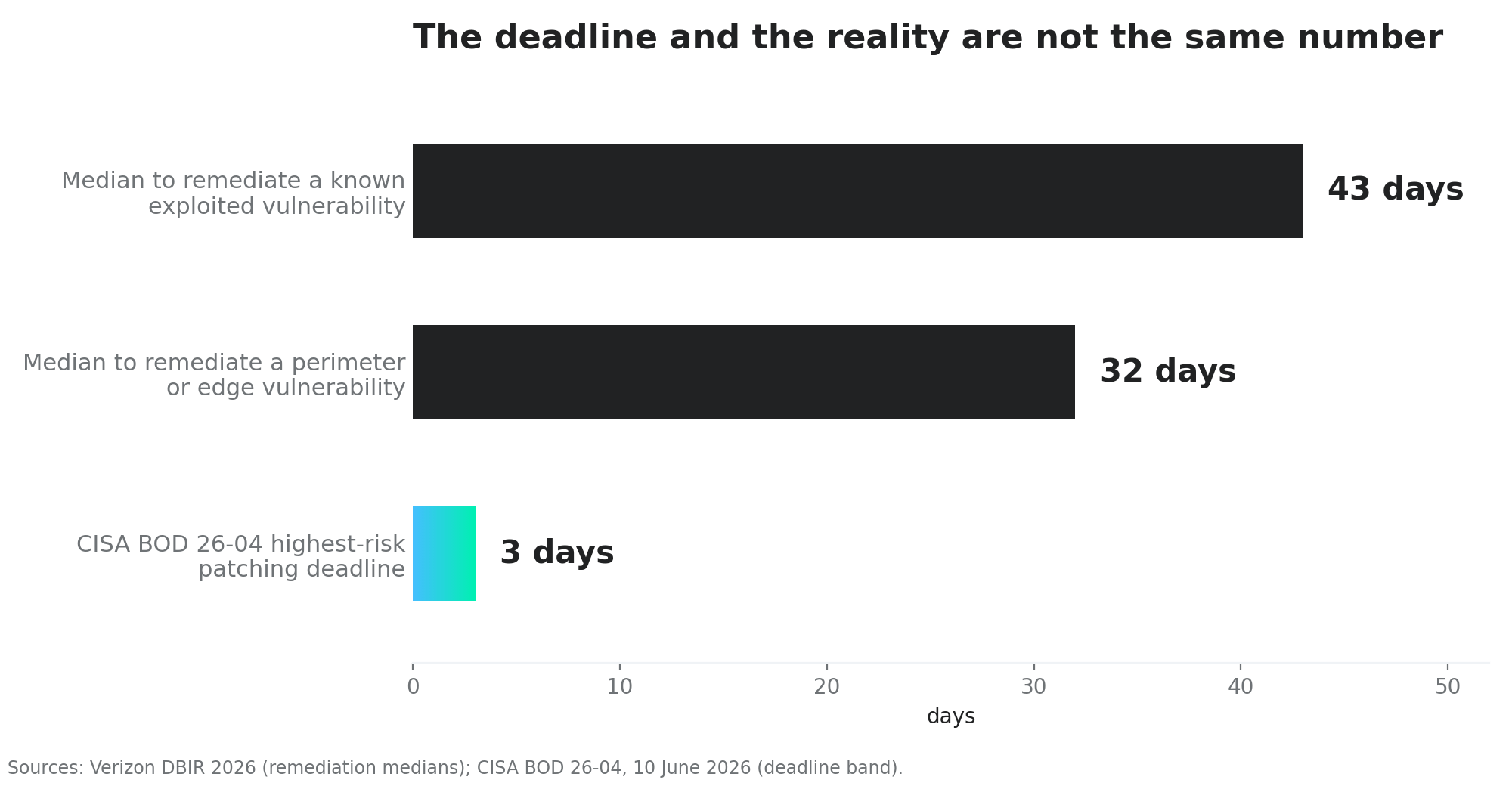
Three days.
That number is the argument. Three days is not a patch window on a Security Management Server. Anyone who has scheduled a jumbo hotfix on one knows what it actually involves: a change board, a maintenance window, a rollback plan, and a Tuesday night. CISA didn't pick three days because three days is achievable. It picked three days because the alternative was worse.
Read the directive it comes from and the admission gets sharper. BOD 26-04, issued on 10 June, replaced the CVSS-driven checklist with a risk decision tree. The fastest band, the three-day one, carries an obligation that has nothing to do with patching: agencies must complete a forensic triage of the affected asset to establish whether it was already compromised before the fix lands. The regulator now writes it down. Applying the patch does not answer the question. Somebody has to go and look.
This is what I mean when I say the security control plane has become the attack surface. Not the workstation, not the mailbox. The appliance that terminates your VPN, the console that distributes your firewall rules, the portal your read-only auditor logs into. Check Point closed two more in the same batch: CVE-2026-62144, another unauthenticated bypass, this one letting an attacker run `run-script` and `exec-command` on the Security Gateway itself, and CVE-2026-62145, a privilege-handling flaw in Gaia Portal that promotes a read-only user to root. The affected range runs from R77.30 to R82.10, which is to say most of what is deployed.
The precondition is almost embarrassing, and it is also beside the point. Remote exploitation requires the Management Server to be reachable from the internet without trusted-client restrictions, exactly the configuration Check Point warns against in its hardening guide. Every organization I talk to will tell you they don't do that. runZero has a business because everyone is wrong about their own inventory.
Now the numbers, because this is not one bad month.
Verizon's 2026 DBIR puts vulnerability exploitation at 31% of confirmed breaches, the top initial access vector for the first time in the report's nineteen years, past credential abuse at 13%. The network edge category, carved out specifically for remote access devices, went from 1.5% to 5% of breaches. Meanwhile the remediation side hasn't moved: perimeter and edge vulnerabilities take a median of 32 days to fully remediate, and 46% are never fully remediated within a year of discovery.
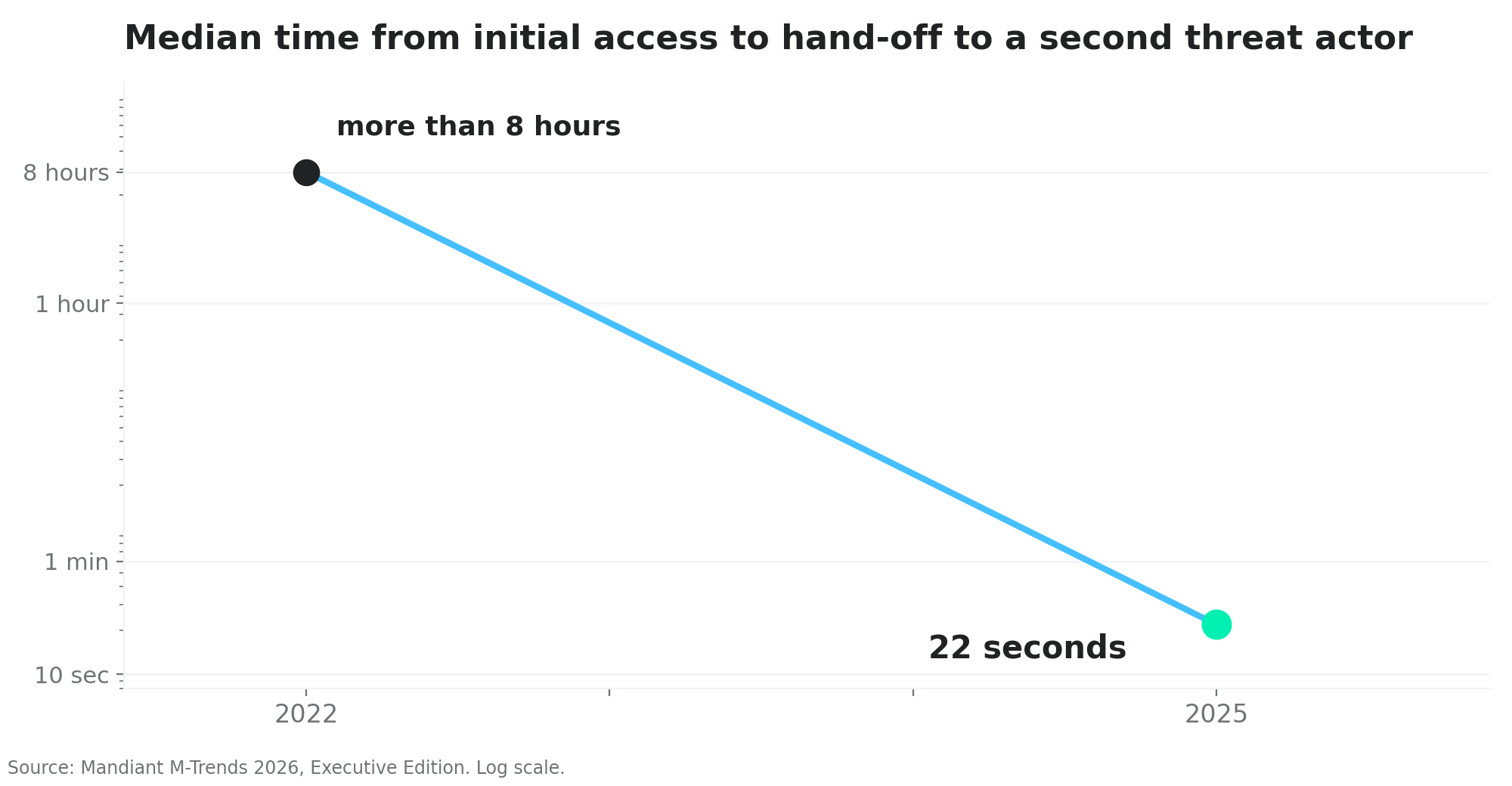
Mandiant's M-Trends 2026 has exploits as the top initial infection vector for the sixth consecutive year, at 32%. It also carries a figure I haven't been able to put down: the median time between an initial access broker establishing a foothold and handing that access to a second actor fell from more than eight hours in 2022 to twenty-two seconds in 2025.
Thirty-two days against twenty-two seconds. There is no version of "patch faster" that closes that gap.
M-Trends also states the reason the edge is a blind spot, in one line: edge appliances can't run traditional EDR, so attackers use them as safe havens. The devices with the most privilege in your architecture are the ones your detection stack has no agent on. Sekoia's own research on ViciousTrap documented what that looks like at scale, edge devices compromised en masse and repurposed as infrastructure.
If you're reading this as a Check Point story, it isn't one. On 1 July, vBulletin patched CVE-2026-61511: `runMaths()`, a function meant to evaluate arithmetic, passes unsanitized input to PHP's `eval()`. Egidio Romano found it, and SSD Secure Disclosure published a working proof of concept, which drops the cost of entry to a copy and paste. Pre-auth remote code execution on an internet-facing application, confirmed by NVD across 5.x through 6.2.1. Different vendor, different decade of code, identical shape. Something reachable, something pre-auth, a patch that exists, and a window that belongs to whoever is watching.
I argued three days ago that the patch race is arithmetically lost. This is the same argument with a smaller number attached. And in the PAN-OS case I wrote up on the 22nd, the intruders didn't break in, they logged in with a valid session, so the entry itself produced almost no signal. An authentication bypass is precisely the class of flaw that leaves nothing at the door.
What it leaves is everything after the door. The policy that changed. The administrative object created at 03:12. The `exec-command` that ran from an address nobody has ever logged in from. Check Point published six IP indicators with the advisory, and an indicator list is worth exactly what your platform does with it. If your answer to "did we ever see 151.241.99.207" is an engineer running a grep next Tuesday, that isn't detection, that's homework.
I'm not going to claim our team had a rule for CVE-2026-16232 on 23 July, because I don't have that in front of me and I'm not going to invent it to sell you something. The claim I'll make is structural, and it's the one that decides whether you find out in twenty-two seconds or thirty-two days. Detection content is not a feature you buy once. It's a living inventory that has to be written, tested and shipped continuously by people who track actors for a living, running on telemetry that includes the appliances no agent can reach, with the investigation logic in front of you rather than behind a verdict. That's what an outcome-based MDR is supposed to buy. Dashboards and coverage percentages are the easy half. The other half is a team and a platform already watching the surface you can't patch in three days. When I say the runbook should be readable and editable by the customer, this is why. You should be able to see exactly what would have caught it.
Check Point gave you a hotfix. CISA gave you three days. Neither of them answers the only question that matters on 31 July, which is whether somebody was already inside before either one arrived.